Ярлыки

(1) ‬ ‪‎водныйспорт (1) ‬ ‪дайвинг в эйлате‬ (1) ‬ ‪‎diving‬ (2) ахладайв (4) глубоководные погружения (2) дайв-центр (2) дайвинг (1) ‪дайвинг в израиле (2) дайвинг в Израиле (1) дайвинг в Эйлате (7) дайвинг для детей (1) дайвинг для новичков‬ (2) дайвинг и сноркелинг (2) дайвинг и снорклинг (4) дайвинг клуб (3) дайвинг курорт (1) дайвинг курсы (4) дайвинг с инструктором (1) дайвинг туры (4) дайвинг фотограф (1) дайвинг центр (4) дайвинг VIP-уровня (1) дайвинг-сафари (1) дайвинг-туры (1) дайвинг-центр (2) Дайвинг-центр в Эйлате (1) дайвингвизраиле (1) дайвингвэйлате (2) дайвингкурорт (1) детский дайвинг (2) дешевые маски (1) израиль (2) Израильский дайвинг-центр (1) инструкторыподайвингу (1) клуб VIP-дайвинга (1) компенсаторов плавучести (1) красноеморе (1) курс обучения дайвингу (7) курс Продвинутого ныряльщика (1) Курс Open Water Diver (1) Курс OWD (1) курсы дайвинга (19) курсыдайвинга (2) лучшие места для дайвинга (7) лучший дайвинг (1) маски с двумя стеклами (1) обучение дайвингу (16) обучениедайвингу (2) ознакомительное погружение с аквалангом (2) погружение (1) подводная фотосьемка (1) подводное снаряжение (2) подводный фотограф (1) подготовительные курсы (1) поиск и подъем (1) пробное дайвинг погружение (1) пробное погружение (2) прогулка на подводном мотоцикле (1) профессиональный курс дайвинга (1) РЭК дайвинг (1) святая земля (1) сертификат за один день (2) скуба дайвинг (5) скуба фотограф (1) Скуба-дайвинг (1) снаряжение дайвинг (1) сноркеллинг (1) спецкурс (1) урок дайвинга (8) уроки дайвинга (1) школа дайвинга (3) эйлат (1) Advanced Open Water Diver (3) ‎AdvancedOpenWaterDiver‬ (1) ahla (8) ahla dive (5) ahla-dive (1) ahladive (14) attractions in Eilat (1) bestdive (1) Book your dive @ www.ahla-dive.com (1) buoyancy compensator (1) certificate for one day (1) cheap masks (1) cheap scuba diving trips (1) children diving (1) Children’s diving (1) ‎childrensdiving‬ (1) chillax (1) coral reef scuba diving (1) course diving (1) courses (1) deepwater diving (1) diingisrael (1) dive-center (1) diveadvisor (1) diver (1) diver training (1) diving (18) diving and snorkeling (1) diving and snorkeling. (1) diving buoyancy (1) diving center (4) Diving center in Eilat (1) diving club (2) diving course (2) Diving courses (2) diving courses in Eilat (1) diving equipment (3) diving for beginners (2) diving for children (1) diving for kids (1) diving for kids. (1) diving holidays (1) diving in Eilat (6) diving in EIlatm ahla dive (1) diving in Israel (3) diving in the Red sea (2) diving instructors (1) diving lesson. (1) diving lessons (1) diving of VIP level (1) diving red sea (1) diving resort (1) diving school (2) diving service (1) diving tour. (1) diving tours (1) diving training (12) diving training courses (1) diving-center (1) ‎divingcenter‬ (1) divingcourses (3) DivingEilat (5) ‎divingforchildren (1) DivinginEilat (2) divinginisrael (1) divingisfun (1) DivingIsrael (2) divingredsea (2) divingsafari (1) divingtour (1) divingtraining (1) divingtraining course (1) divingtrip (2) eilat (1) enjoy (1) equipmentfordivers (1) extreme (1) fundive (1) headachefromdiving (1) hla (1) holiday (1) holidays (1) howtoavoidheadache (1) http://www.ahla-dive.com (1) intodive (1) intro dive (1) introductory dive (2) Introductory scuba dive (1) israel (3) israel_best (1) learnscuba (2) leisuredive (1) marinelife (1) oceananimals (1) Open Water Diver (2) ‎OpenWaterDiver (1) padi diving (1) padidiver (1) paditv (1) Professional diving course (1) properdivingtraining (1) recreation by the Red sea (1) recreation in Israel (1) recreational diving (1) red sea diving (1) red sea scuba diving (1) redsea (1) redseadiving (1) reeflife (1) reefs (1) scuba (8) scuba dive (1) Scuba Diver (1) scuba diving (4) scuba diving holidays (1) scuba diving in (1) scuba diving in Eilat (1) scuba diving navigation (1) scuba diving red sea (1) scuba_diving (1) scubadiverlife (1) ScubaDiving (4) scubadivinglesson‬ (2) seacreatures (1) Search&Recovery (1) snorkeling (3) special course (1) specializeddivingcenterinEilat (1) sun (2) sunnyday (1) the best diving (2) ‎the best places for diving‬ (3) travel (2) traveling (1) travelling (1) twin lens masks (1) underwaterequipment (1) vacation (1) vacationmode (1) VIP diving club (1) vocation (1) water sport (1) what to do in Eilat (1) חגים לצלול (1) חגים צלילה (1) ים אדום צלילה (1) ים סוף צלילה (1) צלילה (1) צלילה אילת (1) צלילה בים האדום (1)
Показаны сообщения с ярлыком Diving courses. Показать все сообщения

воскресенье, 29 января 2017 г.

Diving – important safety measures


AHLA Diving Center attracts the attention of all the people who is keen on scuba diving to the importance of the preparatory step before actual diving. Professional diving training courses offer beginners a chance to learn the information about peculiarities of equipment usage to prevent injuries and spine strains.
We advise you to get acquainted with recommendations of experienced gurus of our diving club.
  1. Ascending to the surface from the deep sea layers should be done slowly (do not exceed the speed of ascending bubbles or 9 meters a minute, or else there is a risk of getting decompression sickness)
  2. Do not neglect the diving hand signals (a system of communication using gestures and signs in diving) with the help of which diving group can communicate. You will always be able to signalize a change in your state of health by the means of special signs.
  3. For each type of diving there are individual restrictions of time spent on specific depths, estimated and planned before the dive. Not only beginners but also experienced divers should mind these restrictions in order for diving to bring only positive emotions.
It is very important for each diver to follow the safety measures not only under water but also on land at the time of equipment transportation. If you attend professional diving courses than you will definitely learn from our experienced diving masters the basic methods to lighten pressure on spine while carrying the diving cylinders, tools and equipment. Same principles and rules exist here as in safe transportation of any heavy loads.
Keep to safety measures and your diving and snorkeling passion will bring you joy and health benefits. Our experienced instructors will create ideal conditions for you to fulfill your dreams of underwater journeys, photo shoots and night diving.

http://ahla-dive.com/eng/blog/safety-in-diving/

пятница, 6 января 2017 г.

Deepwater diving


When it comes to deepwater diving, people who are into diving always have distinctive reaction. Inexperienced divers immediately start asking a lot of questions being interested in details. Those who have already dived deep a few times liven up and start sharing their experience. Amateur divers, who can dive not deeper than the recommended 30-40 meters, also have their eyes lighten up but they act calm, feeling respect to the difficult process.

Qualification of diving beginners is called Open Water and if you have one, than you can dive not deeper than 18 meters. This prohibition has a reasonable basis: these are exploration dives without decompression, gas flow and nitric narcosis. Even if you have dived for only a few times, but have already developed passion for deepwater scuba diving, than you will not get rid of it. Perhaps, you have a natural interest to explore the objects that are situated much deeper than 18 meters? This interest is quite justifiable.
Our dive-center AHLA-DIVE is situated in Israel, in a city of Eilat by the Red Sea in the Gulf of Aqaba. Water temperature is very comfortable both for learning and for diving. The lowest temperature is +21 degrees C, the highest is +29 degrees C.
AHLA-DIVE specializes in recreational diving training. We offer high quality courses, allowing you to improve the qualifications and increase the maximum recommended depths for diving. Diving in Eilat gives you an opportunity to explore new underwater objects, bypassing the restictions of the amateur level.
When we hear the words „Let’s go deeper“ everybody is thrilled with enthusiasm and anticipation of something new and unknown. Mystical depths, exciting adventures, breathtaking discoveries: all this is hidden behind the words diving, scuba diving training, diving courses, diving in Eilat, deepwater diving.
Qualified and experienced instructors carry out diving training with safety and comfort. You will get solid skills. We evaluate the level of qualification for our training staff with the system developed by PADI – professional association of diving instructors.
Training with the program of deepwater diving will reveal to you a whole new world of exploration of the underwater environment. The maximum recommended depth after the training is 30 meters and this means that many of the interesting spots will be available to you. Conditions in which you will dive after the course have to correspond to those you trained in or be better. These restrictions are the result of the necessity to follow security measures.
Sertificates issued by the diving courses of PADI sytem are accepted all over the world. You may not worry that the results of your training will not meet the requirements of some diving center. Certificates have electronic version, so don’t worry about a lost document as the information could be easily checked on the Internet.
Open the door into an exciting world of deepwater diving!


понедельник, 2 января 2017 г.

Discover the incredible underwater world with multilevel diving from “AHLA DIVE”!


Every year more and more people prefer diving as their hobby. This activity can bring a person lots of positive emotions with a huge helping of drive and adrenaline. “AHLA DIVE” diving center that is situated in Israel on the shore of the Red sea in the Gulf of Aqaba offers everybody diving courses with professional instructors of the highest category.

Search and Recovery, drift diving, multilevel diving with a dive computer, equipment, training of experienced divers and beginners – all this is available at our diving center. We cooperate with PADI association, that is why we are the best at what we do. This article is about multilevel diving with a dive computer, which is gaining more and more popularity.

Peculiarities of multilevel diving with a dive computer
Previously there was an unspoken rule in amateur diving – the max time for a person spent under water equals the non decompression limit of a certain depth. This fact set a certain bans, with which a diver could not enjoy the underwater seneries long. His time spent under water was limited. But with the development of new technologies this have changed and now multilevel diving has become available to poeple, What is multilevel diving?


The technique of multilevel diving is based on the fact that at the time of surfacing the speed of oxygen saturation of a body decreses. This means that a diver has to make stops on certain depths stay there for a small period of time. This is required to a gradual nitrogen exiting from a body and decompression sickness prevention.

On diving courses for amateurs this practice has become habitual and allowed people to stay under water longer, and it is now restricted only by the oxygen supply and warmth. This diving technique has become possible due to the employment of underwater computer "Wheel" that calculates the needed stages and intervals.

What miltilevel diving offers a diver?
Multilevel diving offers a diver something what he came into diving for – the maximal time of being under water. In any body of water where bottom relief allows a diver to use this technique, dive computers can be used. This can be coral reefs, deep freshwater lakes, sunken ships and many more.

You start the surfacing with a maximal depth and gradually accend to the surface, making stops at control points. With the help of a dive computer this practice has become habitual. While you are on a certain depths you can explore a reef or enjoy the senery. It is not surprising that many divers consider a dive computer as irreplacable as a mask or fins.


Instructors of "AHLA DIVE" diving school will carry out training of multilevel diving with a dive computer, which will allow you to stay under water longer. We are waiting for you to go through our courses in our diving center in Eilat, Israel.  

http://ahla-dive.com/eng/blog/discover_the_incredible_underwater_world_of_multi-level_dives_from_the_center_of%20%22Ahla%20Dive%20Center!/

четверг, 29 декабря 2016 г.

Master your skill of buoyancy

Human knows little about his body capacity, that is why he cannot hold his breath long under the water and rationally control his body movements. Would you like to learn to swim like a fish in the sea? Diving – is the best way to do it. To feel the level of proficiency it is enough to plunge down deep, where every move requires lots of effort without the skill.
Graceful moving in unison with the sea depth inhabitants singles out a person, who has mastered his skill of buoyancy. Many tourists thing that, paddling with fins vigorously is an effective way to spend energy, but it is a false belief. People, who learned to control their body and increase buoyancy make almost no use of the equipment at the time of moving under water. They are able to keep their body on the same depth within 10 centimeters. What is more, a huge part of buoyancy is the ability to control breathing. Poeple, who are professional divers, spend the air much more rationally as opposed to beginners. Remember that all this comes with practice and the only thing you need is desire.
Some tourists purchase diving tours especially to the Red sea. Regular dives reveal new beauties of the underwater flora and fauna. A large number of trips to the sea bottom does not indicate high skill of buoyancy. Only after finishing diving lessons with an instructor can one master this skill. According to the results of the training a diving school gives their student a certificate. The use of the received skills and knowledge not only gives a person maximum pleasure from diving, but also make a contribution to the environment. Professionals of their craft are able to move along the bottom not damaging the environment which is very important.
Specialist of this field advise the beginners to primarily learn buoyancy and go through a corresponding course. Only after mastering the required skills can beginners get real pleasure from scuba diving. Diving for children finds his true admirers of 12 years old. It is worth noting that learning at an early age is much faster and easier.
Where are these trainings take place and is it possible to learn buoyancy? Diving training takes little time, that's why you can spend a holiday by the Red sea in Israel with to your advantage. In Eilat on the shore the Gulf of Aqaba water temperature has the most comfortable figures for diving courses: from +21 to +29 degress C. It is here that AHLA DIVE diving center is situated, that organizes scuba diving trainings for tourists as well as professionals. Direct cooperation with the instructors of PADI association allows us to carry out quality training in a short tern. Recreational diving has long been under the interest of people, who cannot live without sea fish and other sea inhabitants. Having seen the beauty of the Red sea from the inside, you will definately want to return here again.

To learn the detailed information about the diving course "Perfect Bouyancy" you can visit our site: 

http://ahla-dive.com/eng/blog/bring_skill_in_mastering_the_buoyancy/

воскресенье, 5 июня 2016 г.

Scuba diving for the whole family


Do you want to spend a holiday together with your family but you don’t know what program to choose so it would be interesting and exiting not only for adults but also for the children? You need to go to Eilat in Israel and visit AHLA DIVE diving center.
Scuba diving in the open water is the best kind of active family recreation. Nowadays diving in Eilat is preferred by many Russian and foreign tourists. They set off to the shores of the Red sea to practice scuba diving and enjoy the underwater beauty.
At what age can children start scuba diving?
There are established norms that diving training for children can start at the age of 12. But as a rule the decision when a child starts diving training course has to be made only by the parents.
What season is the most suitable for diving lessons?
Diving courses are generally conducted the whole year. Experienced divers make plunges at any season. But if you want to go on a vacation with your children, you better choose summer diving tours because this time of year the weather and water temperature is the most comfortable.
How dangerous is diving for children?
Every parent has to understand that when children are isolated from the outside world, they are missing out on the opportunity to become independent, learn to count only on their own strength and deal with difficult tasks. Is it really dangerous and should your children be taught diving?

Specialists of AHLA DIVE have certification that allows them to carry out diving training not only for adults but also for the children. Diving courses for children will teach them to follow all the necessary rules making this kind of activity totally safe. What is more, diving and snorkeling help eliminate numerous health problems connected with child’s skeletal system.

четверг, 2 июня 2016 г.

Secrets of saving air – secrets for beginner diver!


Problem of air consumption is familiar to most divers. In the following material you will find tips of its effective saving – useful and practical. Important: this material is aimed at beginners.
15 main tips for proper breathing under water
Diving – is not a competition but still everyone wants to keep their face in front of other team members. The skill of saving air is of great importance, it is taught during diving training courses but the practical part has to be learned on one’s own. Don’t be nervous – Rome was not built in a day you will have time for practice.
In the course of the next dive try to use the following tips:
  1. Trained breathing. Try to make pauses between inhaling and exhaling longer, but it doesn’t have to be too intense.
  2. Breathe as deep as you can. Inhale as though you are doing yoga.
  3. Become a mime. Move under water slowly, smooth as if on a slow motion video.
  4. Помогать руками в ходе плавания не требуется, в противном случае, невесомости не достичь.
  5. Don’t use hand while swimming, otherwise you won’t reach weightlessness.
  6. Work on mastering neutral floatation. Absolute stability is your goal.
  7. Keep horizontal position. Moving sideways leads to unproductive air usage.
  8. Improve streamlining of your equipment.
  9. The best diving is impossible without efficient pressure regulator.
  10. Save the oxygen in the cylinder.
  11. Don’t overload yourself
  12. Don’t freeze yourself, or else you will use more oxygen.
  13. Keep good physical form.
  14. Always improve your level. Learning – is a key to success.
  15. Use your fins properly. Less movements – more benefit.
  16. Don’t compete. Process is more important than winning.

воскресенье, 29 мая 2016 г.

Peculiarities of diver’s certification


To learn the art of underwater diving it is necessary to finish the diving training courses. At the end of the training course, no matter what form or length it is (it can be a full program, consisting of theory, practice in the swimming pool and in the open water or a trial introductory scuba diving lesson), a diver receives a certificate. We would like to point out the peculiarities of diving certification in the following material.
A little history
Diving appeared in Russia in 1995 and at this time first training centers and notion of certification came along. Certificate of aqualunger that were given in USSR are no longer valid. Today there is a large number of diving centers where one can go through diving training of any kind – from Discover scuba diving to full practical-theoretical course.
Where to learn and get certified?
Nowadays there are more than 20 established certificatory organizations in the world, whose certificates theoretically are accepted all over the world. In fact things can be a little different – your certificate may or may not be accepted in other countries and it cannot be foreseen. Sure enough, training in well-known diving centers is always the right choice because they are world-renowned and famous as Oxford or Harvard.
All diving centers belong to somebody and work by their own rules. That is exactly why no one can guarantee that your certification will be 100 % accepted it is better to be ready for that. By the way people who have a plunger or military training cannot do recreational diving without preparatory training. Scuba diving is totally different it has its own peculiarities.

Do you want to finish quality diving training and get a certificate? All this can be done in AHLA DIVE center.

среда, 4 мая 2016 г.

Notable events in diving history (Part 2)


XX century is rich in outstanding events that influenced diving evolution and development.
  • 1908 – physiologists John Scott Haldane, Arthur  Boycott and Gabon Damant carry out a research dedicated to decompression sickness. Achieved data is later used to save lives of numerous divers.
  • 1933 -  foundation of the first diving club “Bottom scrapers”
  • 1936- Eve le Prior organizes a diving center for people who are keen on underwater world exploration.
  • 1938 – Edgar End and Max Noll plunge for 30 meters under water in a pressure chamber. They spent about 27 hours inside of it and at that time one of them experienced signs of decompression sickness.
  • 1939 – a first successful case of rescuing 33 casualties from a wrecked submarine.
  • 1943 – introduction of a modern-day aqualung, that was created with the help of Jaques-Yves Cousteau and Emile Gagnan. Five years later this equipment was used to perform a plunge for 106,8 meters deep it was a world record at the time.
  • 1950 – Georges Houot and Pierre-Henry William reach the depth of 4623,8 meters inside a special apparatus called bathyscaphe.
  • 1959 – foundation of World Underwater Federation.
  • 1960 – Professional Association of Diving Instructors starts its work, based on which our diving training is carried out with later certification.
  • 1962 – underwater  houses are projected
  • 1983 – dive-computer Orca Edge is invented
  • 1985 – Ruins of the “Titanic” are found with the help of remote controlled cameras
  • 1993 г. – прошло 50 лет с момента появления акваланга, в этом году в мире сертифицируется 515 тыс. новых дайверов.
  • 1993 – fifty years after the invention of scuba and on this date 515 thousand divers were certificated.


вторник, 3 мая 2016 г.

Notable events in diving history. (Part 1)


The history of diving evolution goes back for hundreds of years – and since then people have managed to explore the underwater world greatly. AHLA DIVE offers you a chance to get acquainted with the list of the most prominent events in the history of conquering the sea depths. This information will be of interest to professionals as well as beginners who plan to go through diving training courses.
  • 1530 – Introduction of an underwater vessel that can be filled with air.
  • 1650 – a German physicist Otto von Guericke develops a compression device that is later tested on animals by Robert Boyle.
  • 1690 – Edmond Halley an English scientist designs a sphere with a pipe attached to it and a cask with air. The construction could be plunged down for 18 meters and kept under water for an hour and a half.
  • 1715 – John Lethbridge introduces a special diving mechanism to the world. It is made in the form of an oak costume that allows a person to stay deep under water for about half an hour.
  • 1823 - Charles Anthony Deane invents a protective helmet for life guards that is later used in diving. Together with his brother they strike out how this device can be attached to diving equipment with the help of straps.
  • 1843 – the first school is opened in Great Britain where people interested can learn underwater swimming. The institution was different from modern dive-clubs – its graduates became professional dive-rescuers.
  • 1865 – two Frenchmen  Auguste Denayrouze and Benoît Rouquayrol invent an underwater breathing apparatus. It required compressed air, a valve for diver to breathe and a hose to connect it to the surface. This construction was improved and updated and is still used in diving centers.
  • 1876 – a sailor Henry Albert Fleuss designs an aqualung that uses compressed air.


воскресенье, 1 мая 2016 г.


AHLA DIVE attracts the attention of all the people who is keen on scuba diving to the importance of the preparatory step before actual diving. Professional diving training courses offer beginners a chance to learn the information about peculiarities of equipment usage to prevent injuries and spine strains.
We advise you to get acquainted with recommendations of experienced gurus of our diving club.
1.        Ascending to the surface from the deep sea layers should be done slowly (do not exceed the speed of ascending bubbles or 9 meters a minute, or else there is a risk of getting decompression sickness)
2.        Do not neglect the diving hand signals (a system of communication using gestures and signs in diving) with the help of which diving group can communicate. You will always be able to signalize a change in your state of health by the means of special signs.
3.        For each type of diving there are individual restrictions of time spent on specific depths, estimated and planned before the dive. Not only beginners but also experienced divers should mind these restrictions in order for diving to bring only positive emotions.
It is very important for each diver to follow the safety measures not only under water but also on land at the time of equipment transportation. If you attend professional diving courses than you will definitely learn from our experienced diving masters the basic methods to lighten pressure on spine while carrying the diving cylinders, tools and equipment. Same principles and rules exist here as in safe transportation of any heavy loads.

Keep to safety measures and your diving and snorkeling passion will bring you joy and health benefits. Our experienced instructors will create ideal conditions for you to fulfill your dreams of underwater journeys, photo shoots and night diving.

понедельник, 25 апреля 2016 г.

Safety in diving: diving cylinders


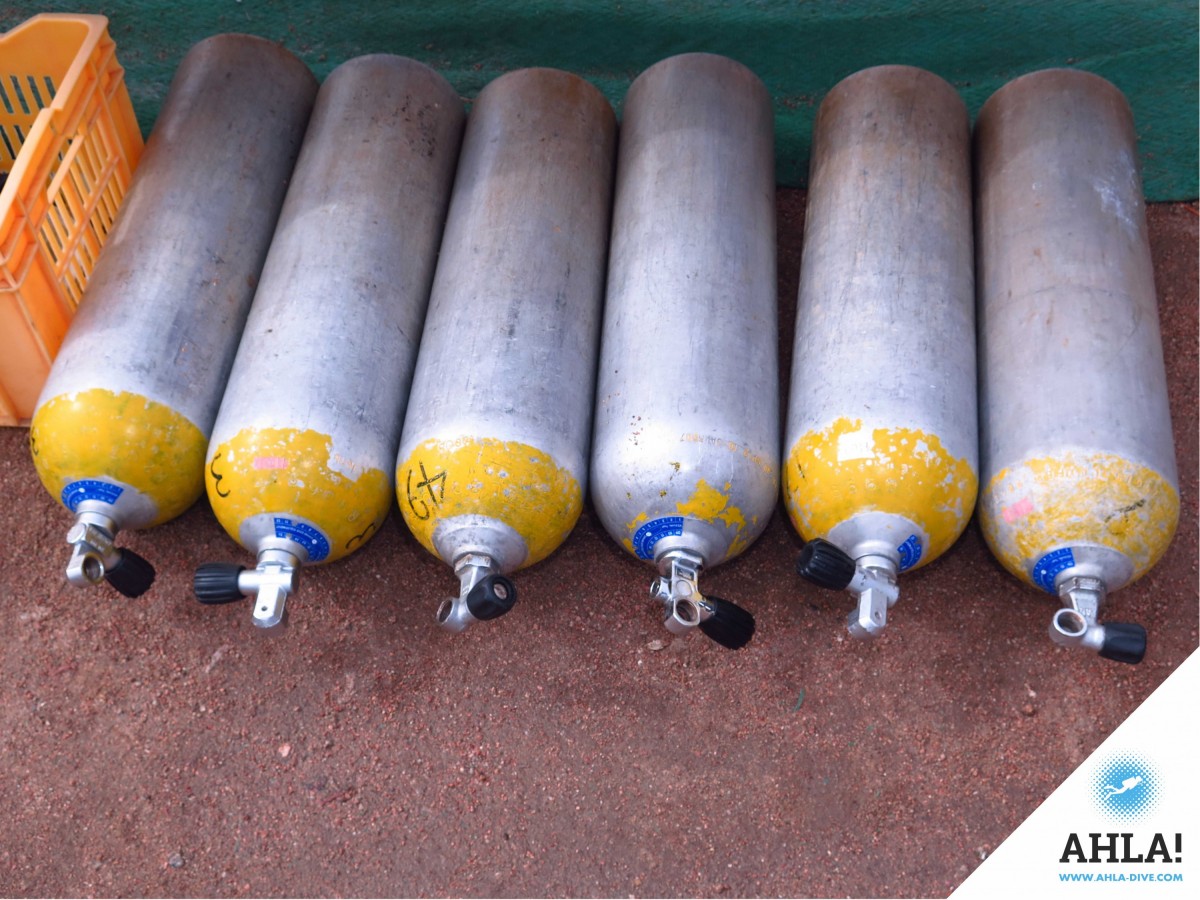
In professional diving a diving cylinder is one of the most important parts of diver’s equipment. Even if you exploit used equipment following the rules of operation will lengthen this element’s life-time.
Rules of exploitation
Having done a systematic analysis, specialists of AHLA DIVE made a list of rules of exploitation of diving cylinders. At first, all beginners who signed up for diving training courses have to look through the “not to do” list:
  • do not subject the device to any mechanical damage, don’t drop it.
  • do not exceed pressure-gauge’s maximum value
  • never dump the cylinder completely, it can lead to water getting inside
  • Do not use equipment with any, even insignificant, external defects.(scars, hollows)
Having learned the forbidden actions beginners should carry on their diving training and learn some of the rules of storage and transportation of equipment:
  • store the equipment in a cool and dry place far from sources of heat. It is necessary to check whether you can hear water splashing inside the cylinder and that there is no damp smell.
  • make a visual check of the equipment regularly and a systematic hydraulic test according to the list of established requirements as well as cleanse the cylinder of the sea water after every usage
  • If you need to move or transport a cylinder, make sure that the valve is tightly wrenched.
Following these rules every diving amateur will not only avoid unexpected problems in the process of diving but also will be able to help their partners.

вторник, 8 марта 2016 г.

Basic safety rules in diving

The first and the most important safety rule is to feel good before dive. It is better to postpone the dive if you have a headache or you feel the consequences of yesterdays’ party or your pressure rises and falls or you generally feel not good. Remember that bad feeling may worsen at depth and lead to dangerous consequences under water.
Today diving course includes a compulsory safety briefing and for those who want to deepen their knowledge exists the course of  Emergence first response. Put your attention that diving is a collective sport that is why each dive is always conducted in a team or with partner. After passing diving courses you may get acquainted with basic techniques that participants communicate. The main thing in scuba diving is not to loose eye contact with your partner and restore it immediately if  you have lost it.
Another obvious factor of the personal safety is the control of the technical condition of equipment and your own health. You have to keep track of dive time and the depth in order the air level not become critical.
In order to avoid decompression load do not ascend quickly. Experienced divers rise up more slowly than air bubble, making short stops at different depths.
There are the best dive sites on the shores of the Red Sea where Ahla-diving center is situated. Amazing sea views and unique flora and fauna conquer your heart by their beauty and unusualness. You should not forget about your own safety while admiring the local representatives. They could be very aggressive if your behavior seems dangerous to them or to their posterity.

среда, 3 февраля 2016 г.

Buddy check in 30 seconds [Part 2]


This is the second part of the article devoted to buddy check.
W – Weights
Put your attention whether your partner has a weight belt or not. If he uses an integrate-weights system check whether packages are inserted and fixed in the right pockets.
R – Releases
Get acquainted with the condition of all your partners’ buckles. It is necessary to check whether they are fastened and tightened. Remember to check the tank strap. Do not miss belayer belt of the tank valve.
A - Air
You have to know for sure that the tank valve is opened or not. Hold the pressure gauge in one hand and regulator in the other. Start forced oxygen supply by pressing the appropriate button. If the gauge arrow retains the position – everything is fine. But if it is moving it means that the valve is closed. And you know that you can’t dive with closed valve under any circumstances.
F – Final check
Conduct a final check of the diver and insure in good condition of his “dress”: that the hoses are not bent or crossed, whether the pressure gauge hose is under the left hand and the spare second stage hose is under the right hand. Are they fixed enough? The spare second stage could be removed without any problems. Let your partner examine the state of the pressure gauge. There is no problem to readout if it is in proper gear. Your partner should take his computer, fins, mask and other equipment that he needs during this dive. And finally “OK”. It means you are ready to go.
Under water look at your partner once again. If you see a leak of oxygen you have to stop the dive and solve the problem with a leak.
Mutual check let you know not only whether your partner is properly equipped but also let you see different types of equipment. It is very useful because in which case you already know what to do with your partners’ equipment.
 It is very important for each of the divers to observe safety and prescribed short course of diving. Yours’ and your partners’ health depends on your vigilance.

Original article: http://ahla-dive.com/eng/blog/baddi-chek-za-30-sekund--vtoraya-chast-/

Buddy check in 30 seconds [ Introduction]

Buddy check in 30 seconds [ Introduction]

Nowadays diving is no longer occupation for the chosen one and all those who are attracted to the sea element can do it. Unfortunately not each course includes all the details of safe diving. A lot of amateurs while diving just forget about important steps that must be completed before going underwater. But in vain – the most important things in any business are safety standards, especially when you deal with the depths.
This article discusses mutual equipment check [Buddy check] which can be done just in 30 seconds. So lets take first things first.
Primarily diver comes to the place where he plans to dive. After that usually everybody discuss upcoming underwater journey, then divide into pairs and wear scuba sets. Although everything seems to be ready, if not one “but”. It is necessary  to check what could be the problem – typically diving courses include the information how to do that. You should read this article very carefully if your instructor did not tell you anything about “buddy check” and also conclude the level of professionalism of that person.
Diver must stand in front of his team-mate. In what order to check partners’ equipment? It’s easy to remember – just hammer into your head one sentence “Big White Rabbits Are Fluffy” as you might guess it is important to remember the order of the first letters – BWRAF.
B – BCD
You need to inflate BCD in order to check each valve that release air. Most often there are three valves – one is located near the inflator: it can be activated by pushing the button, the other two will be opened by pulling the rope.
There are also new trends that we can meet increasingly. It is about the upper emergency valve which is located at the opposite end of the inflator protective hose and also works on the principle of tension.
When the valve is opened it must release air. In case when it happens arbitrarily or it doesn’t happen at all you ought to remove equipment and examine the valves. Often the problem is an accumulated dirt or sea salt.

With other steps of the buddy check you can get acquainted in the second part of the article.

Original original article: http://ahla-dive.com/eng/blog/baddi-chek-za-30-sekund--vtoraya-chast-/